
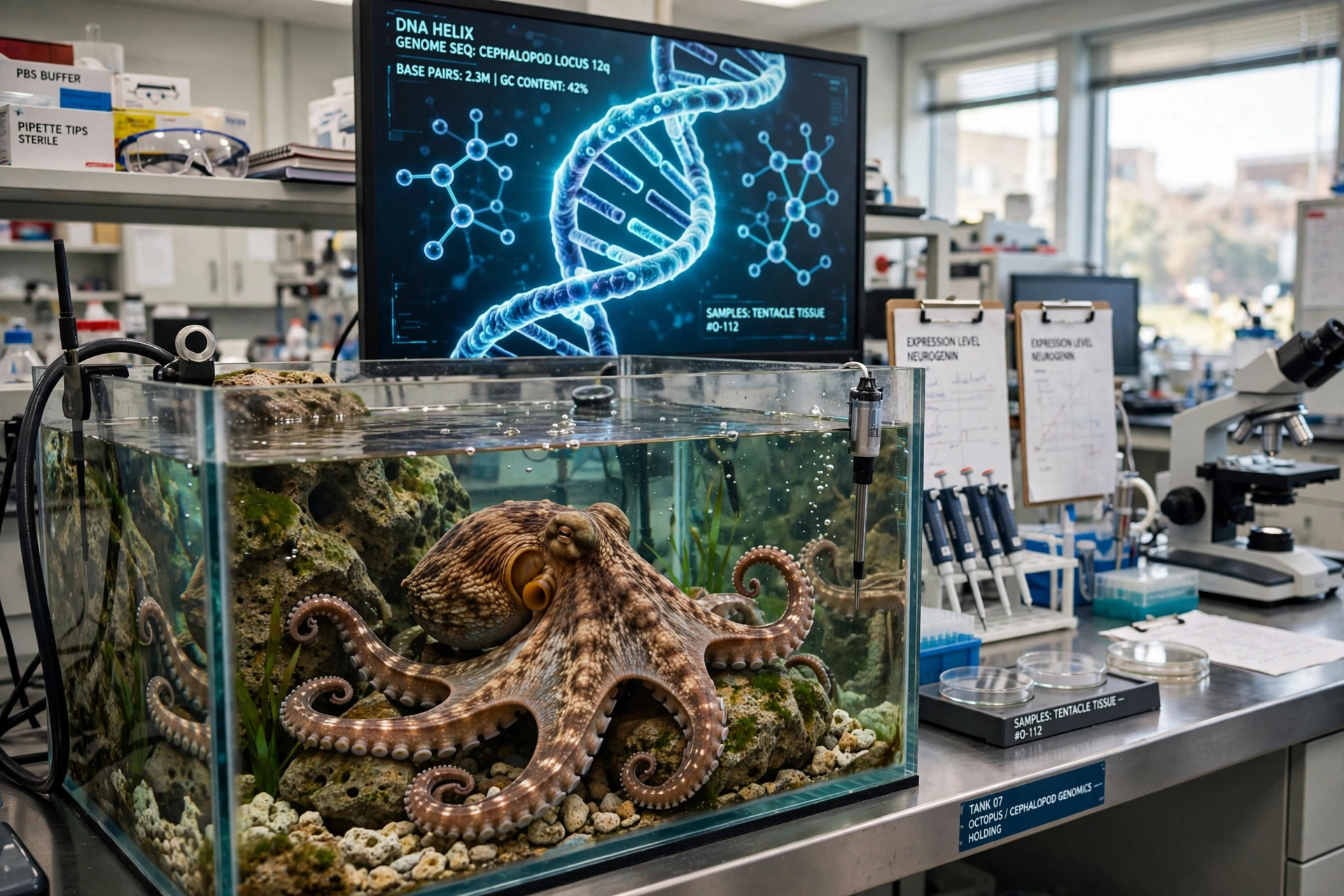
Octopuses can solve puzzles, open jars, change colour in an instant and navigate complex environments with a level of intelligence that has long puzzled biologists. Squid and cuttlefish, their close relatives, show similarly sophisticated behaviour. New research from the University of Vienna now suggests that part of the explanation lies not only in which genes these animals carry, but in how their DNA is folded into three dimensions inside the cell.
The study, published in Nature Communications, examined how the genome is organised in three dimensions across octopus, squid and cuttlefish, a group known as coleoid cephalopods. By combining maps of DNA structure with data on gene activity, the researchers reconstructed what happened after an ancient burst of genome reorganisation that took place hundreds of millions of years ago.
An Ancient Reshuffle That Changed Everything
Genomes are often described as instruction books, but the Vienna team emphasises that they are also physical structures. DNA is folded and looped inside the nucleus, and that folding determines which parts of the genome sit close to one another, even when they are far apart along the linear sequence. When the cephalopod genome was dramatically reshuffled early in the group’s evolution, regions that had previously been distant were brought into close proximity.
That proximity mattered. According to the researchers, neighbouring regions began to interact and influence each other’s activity. Over evolutionary time, those new contacts became embedded, creating increasingly interconnected networks of gene regulation. The team calls this process regulatory entanglement, because once such interactions form, they can become difficult to undo without disrupting essential functions.
Readers who follow science coverage on our homepage will know that gene regulation, rather than gene number alone, is increasingly seen as a driver of biological complexity, and this study adds a striking example.
Stable Domains, Flexible Loops
One of the most interesting findings is that not all levels of genome organisation responded in the same way. Large structural units known as chromatin domains remained largely stable over long evolutionary timescales. They appear to provide a durable framework that preserves core biological functions even after major genomic change.
Finer-scale connections known as chromatin loops behaved very differently. These loops, which bring distant stretches of DNA into direct contact, varied widely between species, between tissues and across developmental stages. Crucially, they were often found near genes involved in distinctive cephalopod traits, including genes linked to the nervous system. That pattern suggests the more flexible parts of genome architecture may be where evolutionary innovation happens most readily.
The full announcement from the university is available in the University of Vienna news release, and the underlying paper appears in Nature Communications in 2026.
Why It Matters Beyond Cephalopods
The findings challenge a common assumption that genome architecture is simply a passive by-product of evolution. Instead, the researchers argue, the three-dimensional organisation of DNA can actively shape how evolution unfolds, opening some paths to new traits while closing others. In cephalopods, that process may have helped produce unusually large and elaborately structured nervous systems, capable of problem-solving, learning and rapid camouflage.
Lead author Dr Thea Rogers and colleagues note that understanding how genome structure evolves is becoming increasingly important for understanding how new forms of biological complexity arise in general. If regulatory entanglement is a widespread mechanism, similar processes could help explain innovation in other animal groups, including vertebrates.
There are practical implications too. Better maps of three-dimensional genome organisation could improve how scientists interpret genetic variation, identify regulatory mutations linked to disease, and design experiments in developmental biology. The work also highlights why model organisms do not always tell the whole story: cephalopods evolved complex brains along a very different evolutionary path from mammals, yet arrived at comparable sophistication.
For now, the study offers a compelling new chapter in one of evolution’s most fascinating stories. The octopus did not become smart by acquiring an entirely new set of genes overnight. Rather, an ancient reshuffling of its genome, followed by hundreds of millions of years of regulatory rewiring, may have gradually built the networks that support its remarkable mind. As three-dimensional genomics advances, researchers expect more such hidden architecture to come into view, in cephalopods and far beyond.
For more background reading from our archive, see our guide on homeowner guide to reliable Sub-Zero refrigerator repair in Lakeway, which shows the breadth of topics covered in this section.