
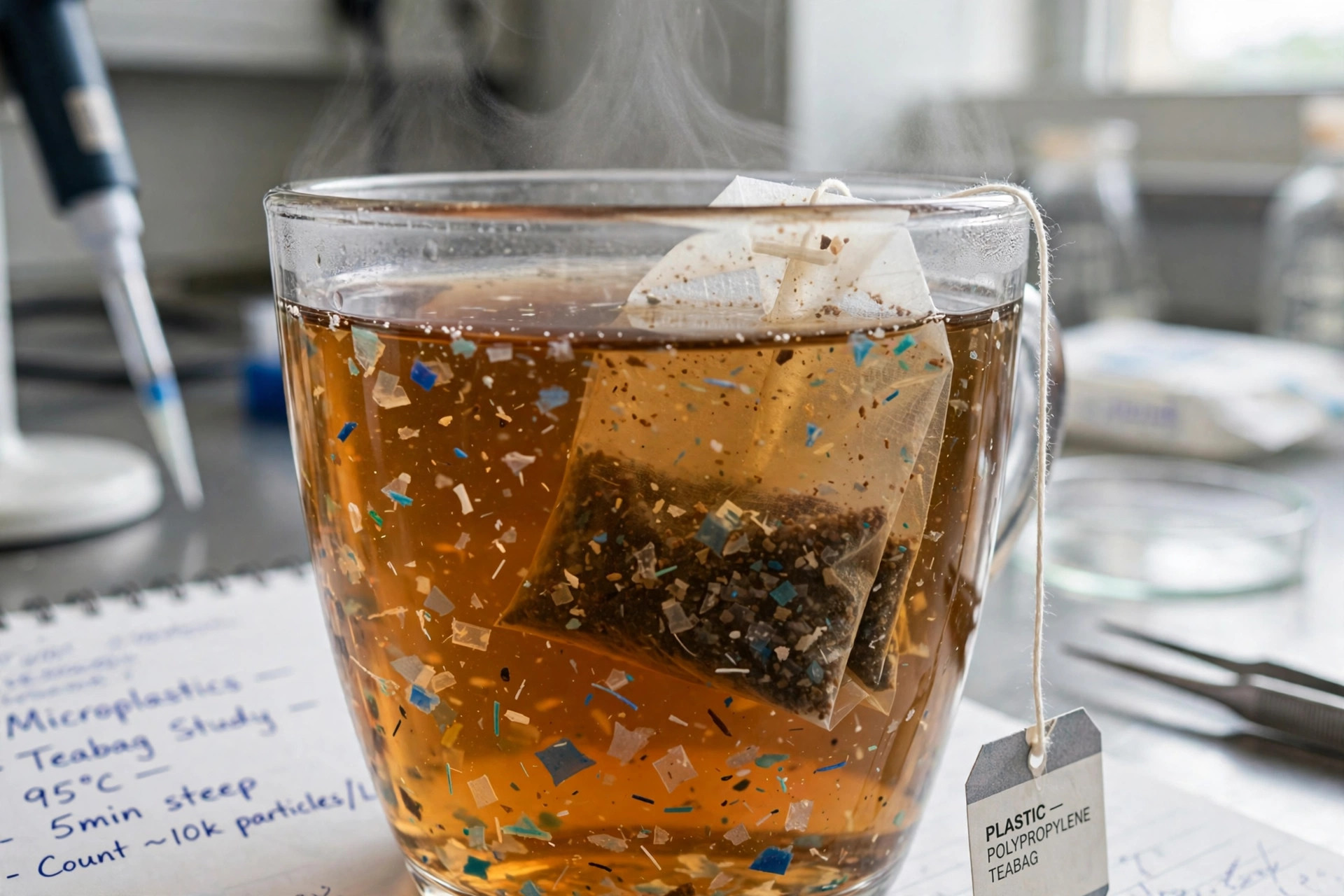
For many people, a cup of tea feels like one of the simplest and healthiest daily rituals. New research, however, suggests that what the tea is brewed in could matter as much as the tea itself. A study of 28 brands, comparing plastic tea bags with loose-leaf, or bulk, tea, found a dramatic difference in microplastic particles ending up in the cup.
Published in npj Science of Food, the research tested 14 bagged and 14 bulk tea brands under controlled brewing conditions designed to mimic a normal cup: water at 95 degrees Celsius for three minutes. The results were stark. Infusions from plastic tea bags contained between 555 and 2,498 microplastic particles per cup, while bulk tea contained only about 0.3 to 2.4 particles per cup.
What the Researchers Actually Measured
The team used spectroscopic analysis to identify the particles and advanced chemical analysis to measure substances migrating from the packaging, including bisphenol A, commonly known as BPA, and phthalate esters, which are used as plasticisers. That combination is important, because concerns about plastic food packaging involve both physical particles and the chemicals that can leach alongside them.
In the tea bag infusions, larger debris, above 100 micrometres, consisted exclusively of polyamide fibres, consistent with the bag material itself breaking down in hot water. In bulk tea, by contrast, the particles were a mixed profile of common plastics, dominated by small fragments. The researchers interpret that pattern as background contamination from the environment and processing, rather than shedding from a bag during brewing.
The original paper, with full methods and data, is available from npj Science of Food on Nature.com.
Particles Are Only Part of the Picture
The chemical findings add nuance. The study modelled overall health risk using a cumulative hazard index, which remained below the threshold of concern. At the same time, estimated BPA intake from bagged tea reached 21.7 percent of the tolerable daily intake set by the European Food Safety Authority. That does not mean a single cup is dangerous, but it does show that a daily habit can contribute a measurable share of exposure to a closely watched chemical.
Scientists are careful on this point: detecting microplastics in a drink is not the same as proving harm in humans, and research into long-term health effects is still developing. What studies like this establish clearly is exposure. Plastic tea bags are not inert containers; in hot water they actively shed material into the infusion.
For broader science and consumer coverage, visit our homepage, where we regularly follow peer-reviewed research on food, health and the environment.
Should You Switch to Loose-Leaf Tea?
Based on their findings, the authors support a shift toward bulk, loose-leaf tea and stricter oversight of food-contact packaging materials. Loose-leaf tea brewed in a metal infuser or a traditional teapot avoids the plastic bag entirely, and in this study it was associated with dramatically lower particle counts, close to background levels.
Consumers who prefer bags do have options. Some brands use paper-based bags without plastic sealants, although labelling is not always clear, and products marketed as biodegradable or plant-based can still behave differently in hot water. Checking manufacturer information, choosing loose-leaf where practical, and avoiding squeezing the bag aggressively are simple steps that may reduce exposure while the science and regulation catch up.
Regulators face a wider question. Tea is consumed globally on an enormous scale, so even small per-cup exposures add up across populations. Clearer standards for what tea bags can be made from, and for how shedding is tested at realistic brewing temperatures, would help shoppers make informed choices without needing to read a scientific paper first.
The takeaway is not to panic about an occasional cup, but to recognise that packaging choices have measurable consequences. A difference between roughly one particle and potentially thousands per cup is hard to ignore. As evidence accumulates, loose-leaf tea looks increasingly like the cleaner, simpler option its fans have long claimed it to be.
Our archive also includes practical household guidance such as the homeowner guide to reliable Sub-Zero refrigerator repair in Lakeway.