
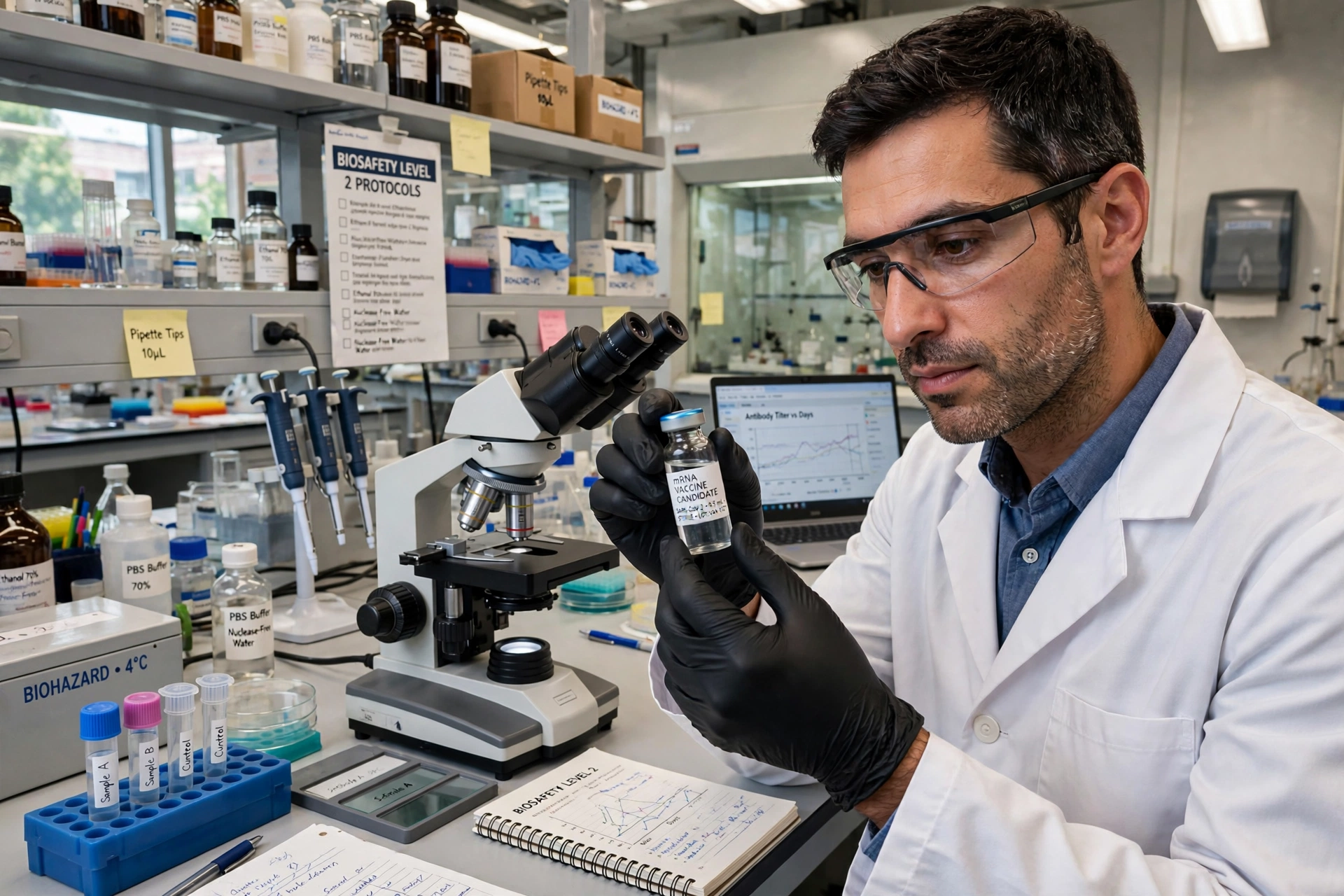
Ovarian cancer that comes back after treatment is one of the hardest problems in oncology, which is why any genuinely new approach deserves attention — and careful wording. A phase 1 trial published in Nature Medicine has tested NeoVax, a vaccine personalised to each patient’s own tumour, given with the immunotherapy drug nivolumab to people with platinum-sensitive recurrent ovarian cancer. The trial’s findings were encouraging in the specific way early trials can be: the vaccines could be made and given, safety was acceptable, and patients’ immune systems responded. Nothing in the study claims a cure, and understanding its limits is as important as understanding its promise.
A Vaccine With One Intended Recipient
NeoVax is not a product that sits in a freezer waiting for any patient. It begins with that patient’s tumour. Cancers carry mutations, and some mutations produce abnormal fragments called neoantigens that appear on tumour cells and nowhere else in the body. Scientists sequence the tumour, predict which neoantigens the immune system is most likely to recognise, and manufacture a vaccine containing those personalised targets. The aim is to train T cells to hunt cells displaying those fragments. The Dana-Farber Cancer Institute has published accessible explainers on this class of vaccines, which help show how different the concept is from a conventional, one-size-fits-all injection.
Nivolumab’s Supporting Role
The vaccine was combined with nivolumab, a PD-1 immune checkpoint inhibitor. Checkpoints are brakes the body uses to prevent immune attacks from damaging healthy tissue, but tumours can exploit them to hide. Blocking PD-1 releases one brake, with the intention of keeping vaccine-trained T cells active once they have been primed. Combining a teaching tool with a brake-release is a rational design, widely explored in modern cancer research. In this early study, however, the combination was being assessed mainly for whether it could be delivered practically and tolerated acceptably alongside a fully personalised manufacturing process — not for whether it extends life.
Feasible, Tolerable, Immunologically Active
Those three phrases summarise the published findings, reported in Nature Medicine. Feasible: individual vaccines were successfully manufactured and administered in a real clinical setting. Tolerable: the safety profile was acceptable to the investigators for this patient group and treatment context. Immunologically active: blood monitoring found T-cell responses aimed at the neoantigens built into each vaccine. Each finding is modest on its own. Together they clear the first gate any personalised therapy must pass. A vaccine that cannot be made in time, cannot be given safely, or provokes no immune response at all has nowhere to go; this one passed all three initial tests.
Holding the Line Against Hype
Early cancer results attract exaggerated headlines, and recurrent ovarian cancer patients are exactly the readers most harmed by them. So it is worth stating plainly what this trial cannot show. It was small. It was in phase 1, the stage designed for safety and feasibility. It was not built to prove that NeoVax plus nivolumab delays recurrence or prolongs survival better than existing care. We apply the same caution on other topics — see our article on what a study of plastic tea bags and microplastics does and does not establish. Good evidence deserves precise language, especially when hope is involved.
Why Specialists Still Call It Progress
If the trial proves so little, why does it matter? Because personalised vaccines live or die on logistics. Every patient requires sequencing, computer prediction, bespoke manufacture and quality checks before a single dose can be given. Demonstrating that this chain can be completed for people with recurrent disease, and paired with checkpoint treatment, converts an attractive theory into an operating clinical process. It also tells the next research teams what to measure, how long manufacture takes, and which immune signals to track when they design the larger studies that can legitimately test benefit.
Looking Ahead, Carefully
The honest outlook is hopeful and restrained at once. Larger trials are needed, with more patients, comparison groups and years of follow-up, before anyone can say whether NeoVax changes outcomes in platinum-sensitive recurrent ovarian cancer. Some promising phase 1 approaches fail at that stage; that is the nature of the process. But a personalised vaccine that can be built from a patient’s own tumour, given with nivolumab, tolerated acceptably and shown to wake up targeted T cells has earned its place in those bigger trials. That — no more, and no less — is what this study established.