
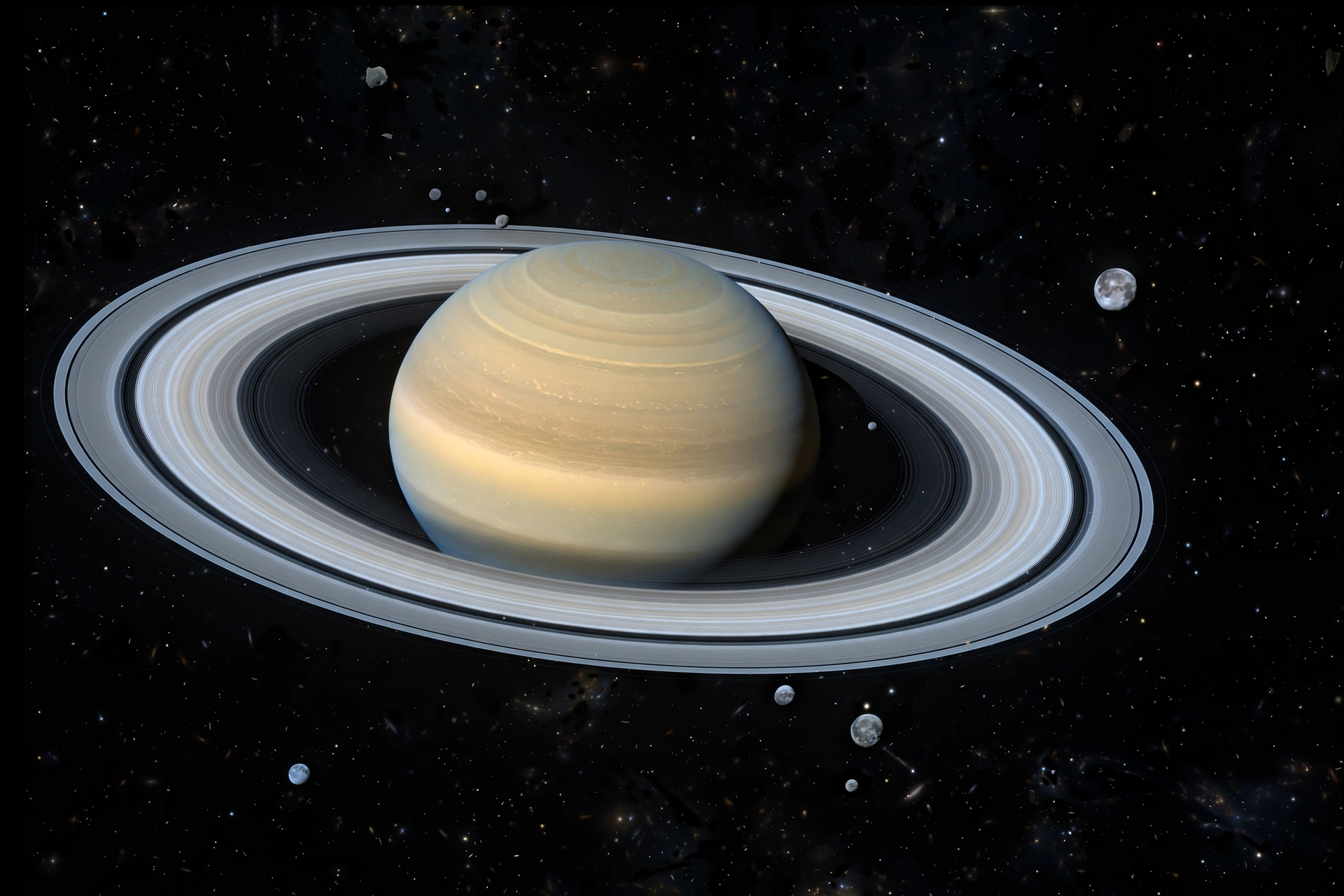
Saturn has always been the showpiece of the night sky, the planet even a small telescope turns into a jewel. Now it has a second claim to fame that is just as lopsided as its rings. Astronomers have confirmed 128 new moons, bringing Saturn’s total to 274 — comfortably more than all the other planets in the solar system combined, and a huge rise from the 146 recognised before. The newcomers are not majestic worlds. They are tiny, dark fragments, only a few kilometres wide, circling far from the planet on strange, tilted paths. Their discovery is a story of patience as much as telescopes.
Years of Images, Stacked With Care
The survey was carried out with the Canada-France-Hawaii Telescope, high on Mauna Kea in Hawaii, using deep images collected over several years. Because each moon is so faint, no single picture could reveal it. Instead the team, which included Dr Edward Ashton and colleagues at the University of British Columbia, used a technique called shift and stack: many images are moved to follow Saturn’s motion and layered together, so faint objects travelling with the planet slowly build into detectable points of light. Formal recognition of the 128 moons by the International Astronomical Union turned years of careful tracking into an official new census.
Captured Wanderers, Not Native Children
Most of the new moons are irregular satellites. They orbit at great distances, on paths tilted sharply away from Saturn’s equator, and many travel retrograde, in the opposite direction to the planet’s rotation. Astronomers read those clues as evidence of capture: these bodies probably formed elsewhere in the young solar system and were seized by Saturn’s gravity as they passed. The NASA pages on the outer planets give a good overview of how different these distant families are from the neat, close-in moons that formed alongside their planet from the same disc of gas and dust.
Broken Pieces of Bigger Moons
Look closer at the orbits and another story emerges. Many of the new moons travel in loose groups with similar paths, suggesting they were once parts of the same larger body. The favoured explanation is that Saturn captured a few sizeable moons long ago, and collisions gradually smashed them into fragments. Each group is a slowly dispersing family of debris. It is a theme this site has touched on before, in a very different setting, in our piece on how cephalopod DNA folds into complex structures: in both cases, researchers reconstruct a hidden history from small pieces arranged in patterns that only make sense together.
Why Count Small, Distant Rocks?
A fair question is why anyone should care about rocks too small to see with the eye. The answer is that a census is a tool. The number of irregular moons, their sizes and their orbits all test ideas about how giant planets captured material, how often collisions occurred, and how debris evolves over billions of years. An incomplete list can mislead those tests badly; a list of 274, built up systematically, is far harder to fool. There is also a simple human pleasure in completeness — the same impulse that makes people finish a collection, catalogue a library or, yes, follow a full season’s results to the very last fixture.
Could the Total Rise Again?
Quite possibly. Shift and stack surveys reward persistence, and deeper images from future telescopes will be sensitive to still smaller fragments. Confirmation, though, will remain slow work, because a moon must be followed long enough for its orbit to be pinned down before the International Astronomical Union will recognise it. Jupiter, Uranus and Neptune will add moons too, but none is remotely close to Saturn’s new figure. A combined total for every other planet that still loses to one ringed world is a statistic unlikely to be overturned in our lifetimes.
A New Answer to an Old Question
Schoolchildren have asked which planet has the most moons for generations, and the honest answer kept changing as telescopes improved. For now, at least, the question has a settled and emphatic answer. Saturn, with 274 confirmed moons, stands alone — a planet orbited by a swarm so numerous that astronomers needed years of stacked images and an international registry just to keep count. The rings made Saturn famous. Its crowd of tiny, captured, collision-born moons may prove, in the long run, to be the more interesting story of the two.